
Yuvix Guide
How to Prepare Your Cycle Records for a Doctor Visit
 Mentari RahmanFounder of Yuvix
 dr. Risdayani R JumarangMedically reviewed, General Practitioner
A clear cycle record makes a doctor visit shorter and more useful. ACOG notes that an ob-gyn will ask when bleeding happens, how much there is, which medicines you take (including over-the-counter ones), your pregnancy history, and your birth control method. Those details are easier to answer accurately when they are written down, because memory is unreliable after a few busy months. This guide covers what to record, how to summarise a three-month window, a template you can copy, questions to ask, and the symptoms that should not wait for a routine appointment. A tracker such as Yuvix can hold this record, but the estimates it shows are not diagnoses.
What to record
Count each cycle from the first day of bleeding. NHS defines day 1 as the first day of your period, and a cycle ends the day before the next period starts. Tracking how symptoms align with the four phases of the menstrual cycle helps clinicians identify whether problems occur predominantly in the follicular or luteal phase. For each cycle, record the following.
- Start and end dates. Write the first day of each period and the last day of bleeding. A period usually lasts about five days, and can range from two to seven days (NHS).
- Flow level. Note whether each day was light, medium, heavy, or spotting, as ACOG suggests. Count how often you change a pad, tampon, or cup, and whether you pass clots. NHS lists clots larger than about 2.5 cm as a sign of heavy periods.
- Pain. Note where the pain is, when it starts, how strong it is on a 0 to 10 scale, and whether it stopped work, school, exercise, or sleep. Period pain usually lasts up to three days (NHS). Also record what helped.
- Bleeding outside your period. Record spotting, bleeding between periods, and bleeding after sex, with dates and amounts. ACOG lists all three as abnormal uterine bleeding.
- Other symptoms. Include unusual discharge, pain during sex, pain when peeing or pooing, and tiredness or breathlessness you notice often. NHS lists these among the signs that heavy periods are affecting you.
- Medicines and supplements. List prescription and over-the-counter products with their start dates. ACOG notes that hormonal birth control can cause bleeding at unexpected times, and that blood thinners and aspirin can increase menstrual bleeding.
- Pregnancy information. If it applies, note whether you could be pregnant, the date and result of any pregnancy test, and any recent pregnancy, miscarriage, or birth. ACOG lists pregnancy-related causes of abnormal bleeding, which is why clinicians ask about pregnancy history.
- Life changes. Note major changes in weight, stress, sleep, or training. NHS lists weight change, stress and anxiety, and exercising too much as common causes of irregular periods.
Summarising a three-month window
Aim for at least three complete cycles. ACOG suggests tracking for several weeks before the visit and noting the dates, length, and type of each bleed on a calendar or in an app. Tracking accompanying lifestyle factors such as exercise by cycle phase, work stress, and sleep disruptions provides additional clinical context for cycle shifts. A longer view matters for ongoing patterns. ACOG describes chronic abnormal uterine bleeding as bleeding that has happened often for at least the past six months. A single unusual cycle is common and does not necessarily mean a problem, though NHS advises that changes in your periods should be looked at.
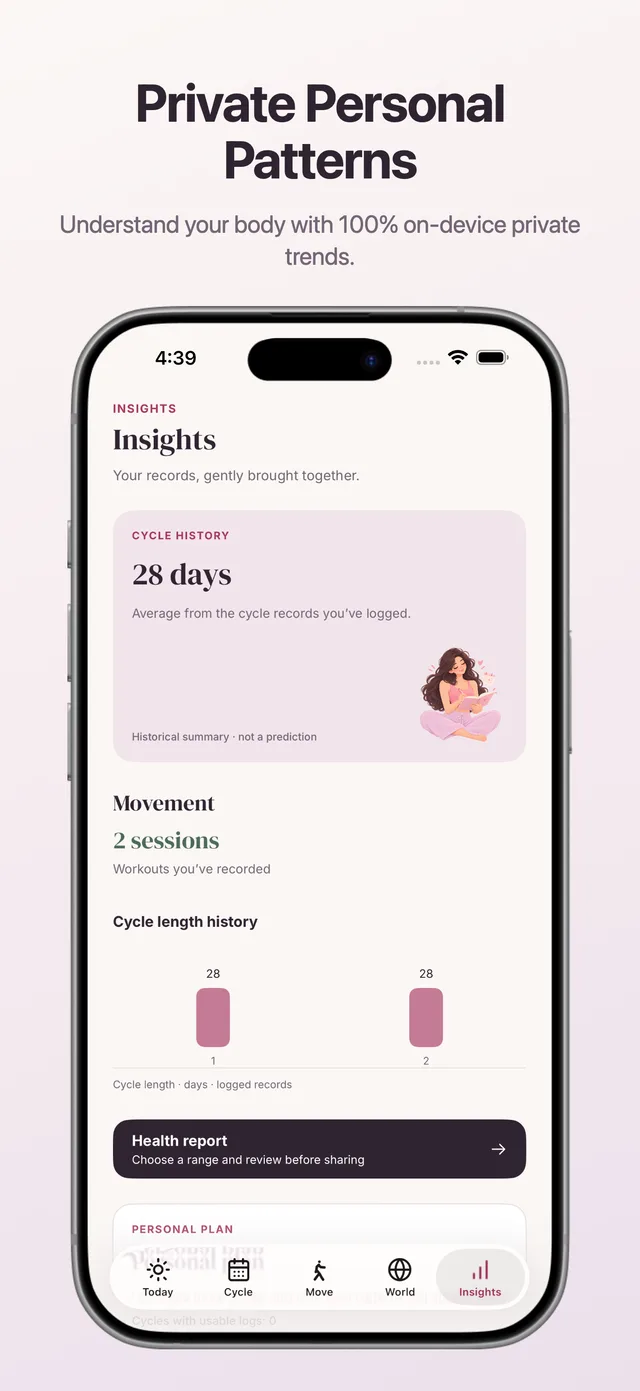
Work through the window in five steps.
- Count cycle lengths. Measure from day 1 of one period to day 1 of the next. Write each length, then note the shortest and longest. Cycles of 21 to 35 days are considered typical (ACOG and NHS).
- Check the variation. ACOG describes periods as irregular when cycle length varies by more than 7 to 9 days. A set of 28, 30, and 41 days varies by 13 days, which is worth raising with a clinician.
- Summarise bleeding per cycle. Record the number of bleeding days, the heaviest day, and how many times you changed protection on that day.
- Summarise pain per cycle. Record the highest pain score, the number of days affected, and the number of days you had to stop usual activities.
- Note what changed. Compare the last three months with the three before. Look for longer or shorter cycles, heavier bleeding, new pain, or bleeding between periods.
Sample summary template
Copy this into a note, a document, or a printed page. Remove any field that does not apply, and add any that do.
- Window: [start date] to [end date] (three cycles)
- Cycle lengths: [days for each cycle], range [shortest] to [longest] days
- Bleeding days per cycle: [numbers]; heaviest day: [date]
- Flow: [light, medium, heavy, or spotting, by day or by cycle]
- Protection changes on the heaviest day: [number]; clots larger than about 2.5 cm: [yes or no, dates]
- Pain: highest [0 to 10], days affected [number], days stopped usual activities [number], what helped [list]
- Bleeding between periods or after sex: [dates and amount]
- Other symptoms: [list with dates]
- Medicines and supplements: [names, doses, start dates]
- Pregnancy: [could be pregnant, yes or no; last test date and result]
- Life changes: [weight, stress, sleep, training]
- Questions for this visit: [one to three]
Example line: cycle lengths of 29, 31, and 30 days, range 29 to 31. Bleeding for 5 days each cycle, heaviest on days 1 and 2, with protection changed every 3 to 4 hours. Pain 6 out of 10 on days 1 and 2, and one day off work.
Questions to ask
Choose the two or three questions that matter most to you, and write them at the top of your summary.
- Is my cycle length and bleeding pattern within the typical range for my age?
- Given my flow and any clots, do I need a blood test to check for anaemia? ACOG notes that a complete blood count can show anaemia or infection.
- Could any of my medicines, contraception, or supplements be affecting my bleeding?
- Which tests do you recommend, and what would each one check?
- Do I need treatment now, or can we monitor for a few more cycles?
- Which changes should bring me back sooner?
Heavy periods do not always need treatment, but treatment can help when they affect daily life (NHS). Options depend on the cause and can range from medicines and contraception to surgery, so ask which ones apply to you.
When not to wait
Some symptoms need prompt care rather than a routine appointment. This list is not complete. If you are unsure, call your GP, NHS 111 in the UK, or your local emergency number.
- Heavy bleeding. Book an appointment soon if your periods last longer than 7 days, soak through one or more pads or tampons every hour, or bleed through to your clothes or bedding (NHS and ACOG). Seek emergency care right away if you have been changing protection every hour for more than two hours in a row and also have chest pain, shortness of breath, or light-headedness (ACOG).
- Bleeding between periods or after sex. This is not usually serious, but it should always be checked by a GP or sexual health clinic (NHS). Causes include hormonal contraception, polyps, fibroids, and infections.
- Bleeding after menopause. Get it checked by a GP, even if it is small or has happened only once. Menopause is usually diagnosed in women over 45 who have not had a period for more than a year (NHS). Bleeding after menopause can be a sign of cancer, which is easier to treat when it is found early.
- Severe pain. Ask for an urgent GP appointment or call NHS 111 if period or pelvic pain is severe or worse than usual and painkillers have not helped (NHS). Call 999 or go to A&E if pelvic pain is severe or getting worse, comes with heavy bleeding, or comes with dizziness, fainting, or vomiting. Pelvic pain with a very high temperature also needs emergency assessment (NHS).
- Possible pregnancy with pain or bleeding. A missed period, unusual bleeding, and pain low on one side of the tummy need urgent assessment, because they can be signs of an ectopic pregnancy (NHS). Call 999 or go to A&E for sudden, sharp, intense tummy pain, dizziness or fainting, or looking very pale (NHS).
- Pregnancy with heavy bleeding. If you are pregnant and soak a pad soon after putting it on, call 999 (NHS).
A tracker should never delay care. Do not wait for a summary to be complete or a prediction to appear before you seek help.
Where Yuvix fits
Yuvix is a privacy-first period and cycle tracker for Android and iOS. Your records stay on your phone, and you do not need an account. Core tracking is free. Premium is $2.99 a month or $19.99 a year. You can export a Doctor-Ready Health Report directly as a PDF without exposing your data to external brokers; learn more in our audit on is a period tracker safe for health data?.
Yuvix predictions are estimates based on the data you log. They are not a diagnosis. Yuvix is not a medical device and is not contraception. A summary is a starting point for your conversation with a clinician, and it does not replace their examination or tests. Share only the dates and symptoms you choose, for example by showing the summary on your phone or printing it for your visit.
Prepare clean, private cycle reports with Yuvix. Generate doctor-ready summaries on your phone without cloud accounts or third-party ad tracking.


Frequently Asked Questions
What is the most important data point to show my gynecologist?+
The start date of bleeding (Day 1) for each cycle, the duration of bleeding, flow volume (pads soaked per day), and whether pain disrupts daily activities.
How many months of records do doctors prefer to see?+
Clinicians universally prefer a 3-month to 6-month prospective summary. A single unusual cycle is common, but 3 months reveals whether an irregularity is chronic.
What bleeding symptoms require emergency care rather than a scheduled visit?+
Soaking through two or more maxi pads or tampons every hour for two hours in a row, passing blood clots larger than a quarter, or bleeding accompanied by dizziness or severe pelvic pain (ACOG).


Sources
- ACOG, "Abnormal Uterine Bleeding" (FAQ), https://www.acog.org/womens-health/faqs/abnormal-uterine-bleeding
- NHS, "Periods", https://www.nhs.uk/conditions/periods/
- NHS, "Heavy periods", https://www.nhs.uk/conditions/heavy-periods/
- NHS, "Irregular periods", https://www.nhs.uk/symptoms/irregular-periods/
- NHS, "Period pain", https://www.nhs.uk/symptoms/period-pain/
- NHS, "Vaginal bleeding between periods or after sex", https://www.nhs.uk/symptoms/vaginal-bleeding-between-periods-or-after-sex/
- NHS, "Postmenopausal bleeding", https://www.nhs.uk/symptoms/post-menopausal-bleeding/
- NHS, "Pelvic inflammatory disease", https://www.nhs.uk/conditions/pelvic-inflammatory-disease-pid/
- NHS, "Ectopic pregnancy", https://www.nhs.uk/conditions/ectopic-pregnancy/
- NHS, "Vaginal bleeding in pregnancy", https://www.nhs.uk/pregnancy/common-symptoms/vaginal-bleeding/
Health information only. Yuvix does not diagnose conditions.
Discussion & Reader Q&A
Moderated CommunityI printed my 3-month summary and brought it to my appointment. My OB-GYN was so impressed because it saved 15 minutes of guessing dates.
Leave a Comment or Question
Share your experience or ask a question about this guide. Links and URLs are automatically blocked.