
Yuvix Guide
Exercise by Cycle Phase: What to Do Each Week
 Mentari RahmanFounder of Yuvix
 dr. Risdayani R JumarangMedically reviewed, General Practitioner
Many people notice that training feels easier in some weeks than others. This guide explains what the research says about exercise across the menstrual cycle, gives sample workouts for each phase, and lists when to scale back. It is general information, not a training plan. Studies on cycle phase and performance are mixed, and individual responses vary widely.
What the research shows
Research on exercise and the menstrual cycle usually divides the cycle into phases based on hormone patterns. In the early follicular phase, estrogen and progesterone are both low. Around ovulation, estrogen is high and progesterone is low. In the mid-luteal phase, both hormones are high (McNulty et al., 2020). For a detailed physiological breakdown of these hormone shifts, read our guide to the four phases of the menstrual cycle.
A 2020 systematic review and meta-analysis of 78 studies in women with regular cycles found that exercise performance might be trivially reduced in the early follicular phase compared with other phases. The effect was small, between-study variation was large, and most included studies were rated low quality. The authors concluded that general guidelines could not be formed and recommended a personalised approach based on each person's own response (McNulty et al., 2020).
The practical takeaway is that the cycle is a useful lens for noticing your own pattern. It is not an inflexible rule for what you must do each day.
Phase by phase: energy and recovery
Menstruation (about the first days of bleeding)
Bleeding length varies from person to person. More than half of people who menstruate have some pain for one to two days a month, and for some it is severe enough to disrupt several days (ACOG, Dysmenorrhea). Energy may be lower in the first days for some people, while others feel normal. Let symptoms guide how hard you train.
Early follicular phase (after bleeding, before ovulation)
This is the phase the meta-analysis linked to a trivial dip in performance. Because the difference is small, you do not need to avoid hard training here. If you feel flat, reduce the load or volume of the session rather than skipping it. This is also a sensible time to start a new strength routine and increase load gradually.
Ovulation (around mid-cycle)
Ovulation is the window when some people feel strongest. The meta-analysis did not identify a consistent peak across studies, so treat this phase as a chance to try a harder session if you feel well, not as a guarantee. Warm up thoroughly before any high-intensity work.
Luteal phase (after ovulation, before the next period)
The luteal phase is usually around two weeks, although its length varies. It begins after ovulation and ends when bleeding starts, so the days before a period are the most common time to notice changes. Progesterone and estrogen are both high in the middle of this phase. Some people notice more fatigue, bloating or sensitivity to heat before bleeding starts. Steady, moderate training often feels better than maximal efforts for these people. Focus on consistency rather than personal bests.
Sample workouts by phase
These are starting points. Choose sessions that match your fitness level, and adjust them as you learn your own pattern.
- Menstruation: a walk at a conversational pace, gentle cycling, a yoga or mobility flow, and light strength work with lighter loads if you feel up to it.
- Early follicular: a progressive strength session built around the main lifts, plus a few short intervals with full recovery between them. Add load in small steps.
- Ovulation: one planned harder session, such as intervals or heavier sets after a full warm-up, if you feel well.
- Luteal: moderate steady cardio at a pace where you can talk in full sentences, strength work with the same exercises but fewer hard sets, and a longer cooldown with mobility work.
- Every phase: daily walking and short mobility work keep the routine consistent.
Intensity, hydration and sleep
Use a talk test. On easy days you can speak in full sentences. On hard days you can manage only a few words. Because the performance differences across the cycle are small and inconsistent (McNulty et al., 2020), your recent recovery, sleep and stress are often better guides than the calendar.
If you slept badly or are under high stress, reduce intensity for that day, whatever phase you are in. Drink fluids through the day, and drink more in heat or after long or sweaty sessions. Thirst is a reasonable guide for most healthy adults. Warmth from a heating pad or warm bath can make a session more comfortable if you have cramps.
Adjusting for cramps, heavy bleeding or PMS
Cramps. Exercise may reduce menstrual pain compared with no exercise. A Cochrane review found that the evidence is of low to very low quality, and it could not determine whether exercise works better than NSAIDs (Armour et al., 2019). A 2021 American Family Physician summary reported that both low-intensity exercise, such as stretching and core work, and high-intensity exercise, such as aerobic training, were associated with less menstrual pain (American Family Physician, 2021). Start gently, let the warm-up show how much you can manage, and stop if pain increases.
Heavy bleeding. If bleeding is heavier than usual, or you feel unusually tired or short of breath, reduce training to gentle movement and rest more between sets. Heavy bleeding is worth discussing with a clinician rather than managing through exercise alone; see our checklist on how to prepare your cycle records for a doctor visit.
PMS. If symptoms such as fatigue, bloating or irritability are strong or regular, plan lighter sessions for those days and note the pattern in your tracker. Pain that is much worse than your usual cramps, or that is new, should be checked by a clinician.
A simple way to use this
Log your period dates, energy, sleep and how each workout felt for two or three cycles. Look for patterns in your own notes before you change a plan. A single cycle rarely settles a question, so a pattern that repeats carries more weight than one good or bad week. Keep the changes small, and review them after a few weeks. If you are comparing mobile apps to record workouts alongside cycle symptoms, check our period tracker comparison worksheet.
Where Yuvix fits
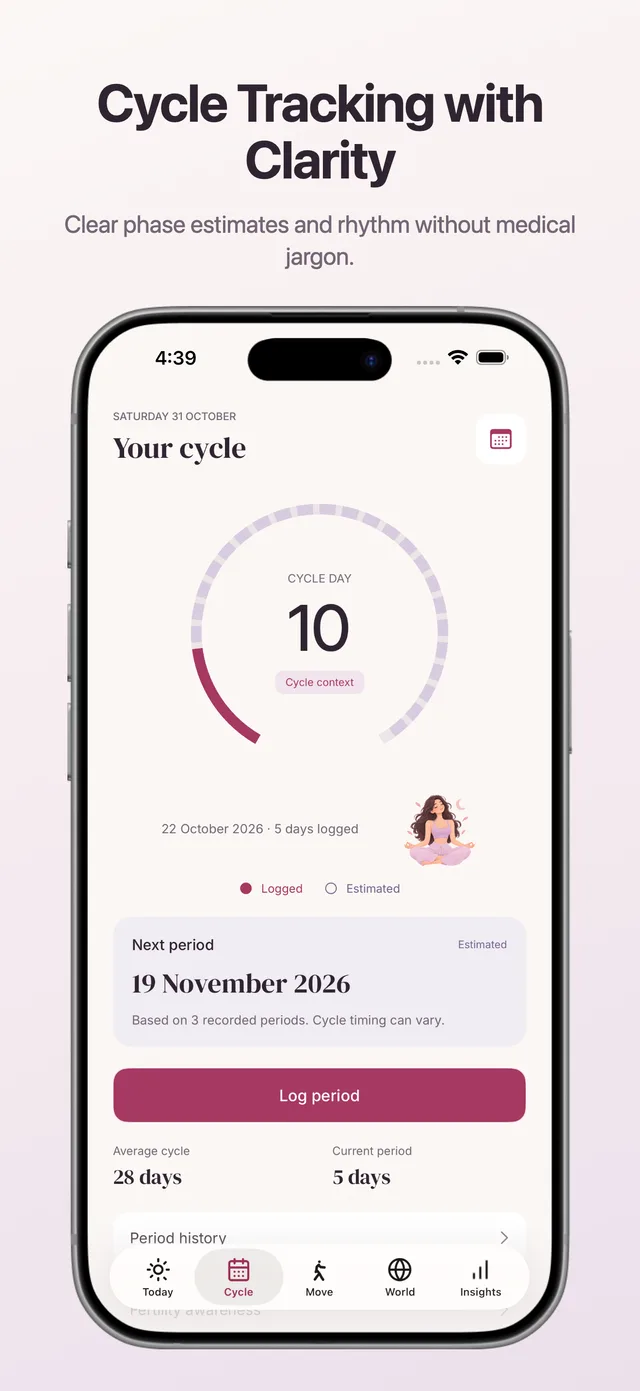
Yuvix is a privacy-first period and cycle tracker for Android and iOS. You can log period dates, flow, symptoms, and workout intensity, then look for patterns across several cycles without third-party tracking. Records stay on your phone, and no account is required. Yuvix does not prescribe exercise, is not a medical device, and is not contraception. Its predictions are estimates from the data you log.
Track your workouts and cycle phases privately with Yuvix. Log exercise notes, symptoms, and period flow directly on your phone. Encrypted locally with zero cloud trackers.


When to talk to a clinician
Individual responses vary, and general patterns may not describe your body. Athletes and people training for competition, and people with conditions such as PCOS, endometriosis, thyroid disease or a bleeding disorder, should consult a clinician before changing training around their cycle. Stop exercising and seek medical care if you have chest pain, dizziness, fainting, or pain that does not settle with rest.
Frequently Asked Questions
Should I completely stop working out during my period?+
No. Light exercise, walking, and gentle yoga can stimulate blood flow and release endorphins that alleviate menstrual cramps. Listen to your body and scale intensity as needed.
Why do I feel stronger during the late follicular phase and ovulation?+
Rising estrogen and testosterone peak around mid-cycle, enhancing muscle glycogen storage, energy, and neuromuscular drive in many individuals.
Why is hydration and recovery harder during the luteal phase?+
Progesterone slightly elevates basal body temperature and increases sodium excretion, meaning you may sweat more easily and require longer recovery times between sets.
Sources
- McNulty KL, Elliott-Sale KJ, Dolan E, Swinton PA, et al. "The Effects of Menstrual Cycle Phase on Exercise Performance in Eumenorrheic Women: A Systematic Review and Meta-Analysis." Sports Medicine 50 (2020): 1813-1827. https://link.springer.com/article/10.1007/s40279-020-01319-3
- Armour M, et al. "Exercise for dysmenorrhoea." Cochrane Database of Systematic Reviews (2019), CD004142. https://www.cochranelibrary.com/cdsr/doi/10.1002/14651858.CD004142.pub4/full
- American Family Physician. "Exercise for Dysmenorrhea." 2021 May 1. https://www.aafp.org/afp/2021/0501/p525
- American College of Obstetricians and Gynecologists. "Dysmenorrhea: Painful Periods." https://www.acog.org/womens-health/faqs/Dysmenorrhea-Painful-Periods
Health information only. Yuvix does not provide exercise prescriptions.
Discussion & Reader Q&A
Moderated CommunityAdjusting my heavy leg days to the late follicular phase instead of right before my period was a game changer for my recovery.
Leave a Comment or Question
Share your experience or ask a question about this guide. Links and URLs are automatically blocked.