
Yuvix Guide
The Four Phases of the Menstrual Cycle
 Mentari RahmanFounder of Yuvix
 dr. Risdayani R JumarangMedically reviewed, General Practitioner
Most people notice their cycle only when a period starts. Hormonally, though, the cycle is a repeating series of changes that runs through the whole month. Clinicians usually describe it in four phases: menstruation, the follicular phase, ovulation, and the luteal phase. Learning what each phase does lets you read your own pattern instead of judging each day on its own.
This guide covers the hormones behind each phase, typical timing and how much it varies, how a simple log reveals patterns, and when to see a doctor. It is general information and does not replace an assessment by a healthcare professional.
How the cycle is counted and what is typical
The cycle starts on the first day of bleeding, which is day 1, and ends the day before the next period (Merck Manual Consumer Version). For a detailed walkthrough on counting days and spotting cycle variation, see our guide on how to calculate your menstrual cycle length. For most adults a regular cycle falls between 21 and 35 days (NHS; NICHD). The median in the Merck Manual Professional Edition is 28 days, with a normal range of 24 to 38 days. A 28-day cycle is a common average, not a target. Cycles vary most in the years just after the first period and in the years before menopause (Merck Manual Consumer Version).
Typical lengths of each phase:
- Menstruation: usually 2 to 7 days, with an average of about 5 days (NHS; NICHD).
- Follicular phase: about 13 to 14 days on average, and the phase that varies most in length (Merck Manual Consumer Version).
- Ovulation: anywhere from about day 10 to day 21. In a 28-day cycle it usually falls around day 12 to 14 (NICHD).
- Luteal phase: about 14 days, and the most consistent phase in length (Merck Manual Professional Edition).
Hormones run the cycle. The hypothalamus releases gonadotropin-releasing hormone (GnRH) in pulses every 1 to 4 hours. GnRH prompts the pituitary gland to release luteinizing hormone (LH) and follicle-stimulating hormone (FSH). These drive the ovaries to produce estradiol, a form of estrogen, and progesterone (Merck Manual Professional Edition). Estrogen and progesterone act on the uterus and breasts, and they feed back on the brain, which is why their levels rise and fall in a fairly predictable order across the month.
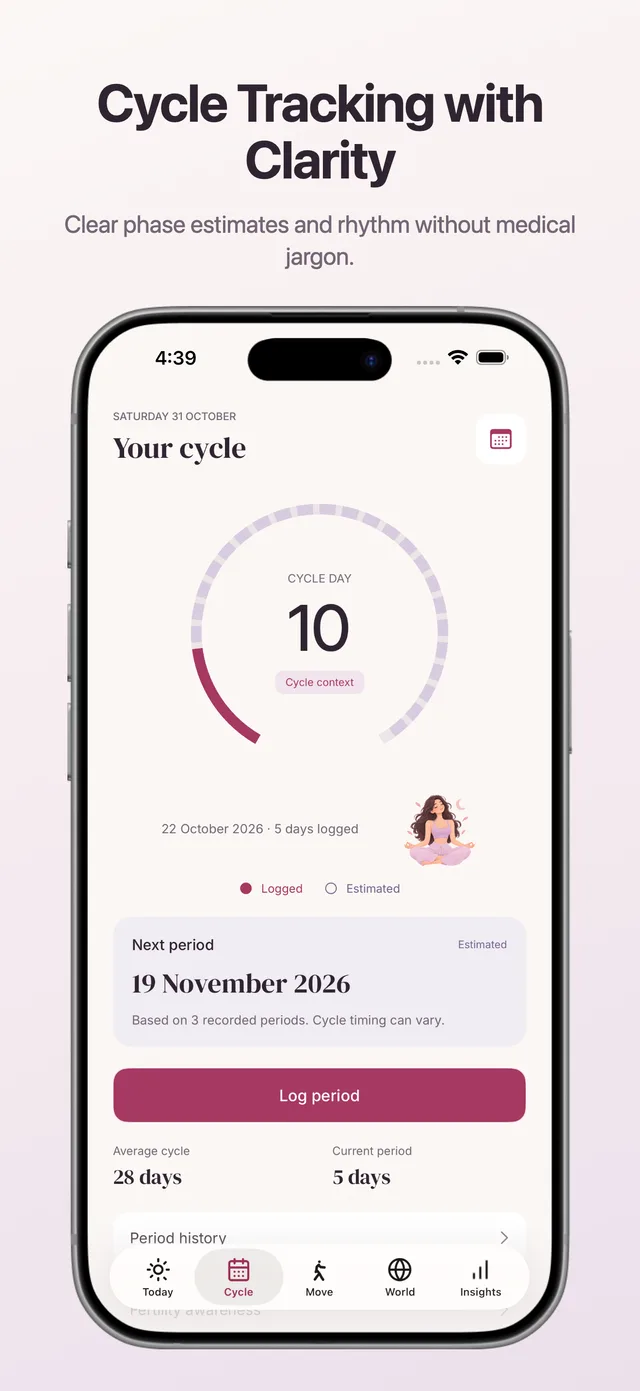
1. Menstruation
Menstruation is the shedding of the uterine lining, the endometrium, together with bleeding. It starts when estrogen and progesterone are low because no pregnancy has occurred. The top layers of the lining are released, and that bleeding is the period (Merck Manual Consumer Version; Merck Manual Professional Edition).
A period usually lasts 2 to 7 days (NHS). Merck gives a slightly wider range of 4 to 8 days for bleeding (Merck Manual Consumer Version). Blood loss per cycle averages about 30 mL, with a normal range of 5 to 80 mL, and is usually greatest on the second day (Merck Manual Professional Edition). Menstrual blood usually does not clot unless the bleeding is very heavy (Merck Manual Consumer Version).
Cramps are common. They happen because the womb contracts to push out blood (NHS). Light movement and stretching can help ease menstrual pain; you can read our evidence-based recommendations on adapting your workouts in our guide to exercise by cycle phase. Over-the-counter painkillers such as paracetamol or ibuprofen can also help, but do not take ibuprofen or aspirin if you have asthma, stomach ulcers, kidney, or liver conditions without medical advice (NHS). If cramps severely disrupt your daily routines, see a clinician (NHS).
2. Follicular phase
The follicular phase starts on day 1 and ends at ovulation. Its main job is to bring one egg-containing follicle to maturity. Early in the phase, FSH rises slightly and stimulates the growth of 3 to 30 follicles. Usually only one becomes dominant, and the others break down (Merck Manual Consumer Version; Merck Manual Professional Edition).
The dominant follicle makes more and more estradiol. Estrogen rises once bleeding ends, around day 5 in an average cycle (NICHD). Estrogen also rebuilds the endometrium to its full thickness late in this phase, and it makes cervical mucus more plentiful and stretchy (Merck Manual Professional Edition). By late in the phase the follicle is typically 18 to 20 mm across (Merck Manual Professional Edition).
3. Ovulation
Ovulation is the release of an egg from the ovary. It is triggered by an LH surge. Estradiol peaks as the ovulatory phase begins. The LH surge usually lasts 36 to 48 hours, and the egg is released within about 16 to 32 hours of the surge beginning (Merck Manual Professional Edition). Progesterone starts to rise at this point as well.
Some signs can help you spot the window:
- Cervical mucus that is clear, thin and stretchy, similar to raw egg white (NHS).
- Mid-cycle pain on one side of the lower abdomen, called mittelschmerz. It may last a few minutes or 1 to 2 days (NHS).
- A rise in LH in urine, which home ovulation tests can detect (NICHD; Merck Manual Consumer Version).
No single sign confirms ovulation, and many people notice none of them. The fertile window is about six days, starting five days before ovulation and ending one day after. Sperm can live 3 to 5 days, and an egg can be fertilized for up to about 12 hours after release (Merck Manual Consumer Version). Knowing this window is not a way to prevent pregnancy, and Yuvix estimates should not be used for that purpose.
4. Luteal phase
After ovulation, the follicle closes and becomes the corpus luteum, a temporary structure that makes progesterone. Progesterone is the main hormone of this phase. It peaks about 6 to 8 days after ovulation, at roughly 25 mg per day (Merck Manual Professional Edition). It prepares the endometrium for a possible embryo and thickens cervical mucus, which makes it harder for sperm or bacteria to enter the uterus (Merck Manual Consumer Version; Merck Manual Professional Edition).
Progesterone also raises basal body temperature by about 0.5 °C, and the rise lasts until a period begins (Merck Manual Professional Edition).
This phase averages about 14 days (Merck Manual Professional Edition). If pregnancy does not occur, the corpus luteum breaks down, estrogen and progesterone fall, and a new period begins (NHS; Merck Manual Consumer Version). If an embryo implants, the developing pregnancy produces hCG, which keeps the corpus luteum producing progesterone (Merck Manual Consumer Version).
Premenstrual symptoms usually start in the two weeks before a period and ease once bleeding starts (NHS). Not everyone has them. Common ones include mood swings, feeling low or irritable, headaches, tiredness, bloating and breast tenderness (NHS). PMS is thought to be linked to changing hormone levels across the cycle, and its severity varies from person to person (NHS).
Using a log to spot patterns
One cycle rarely tells you much. Patterns become clearer across several cycles than from any single month. A useful log records:
- The first day of each period and the day bleeding ends.
- Flow each day, and how many pads, tampons, or cups it takes.
- Symptoms such as cramps, headaches, breast tenderness, mood, sleep and energy.
- Any pain or bleeding between periods, and when it occurs in the cycle.
- Results from ovulation tests or temperature readings, if you use them.
- Events that may shift timing, such as illness, travel, stress, or changes in weight or training.
Look for a steady cycle length, symptoms that appear at the same point before bleeding, and mid-cycle pain or spotting that repeats. Compare these with clinical reference ranges rather than an idealized 28-day month. ACOG suggests keeping a chart of bleeding days and flow volume to bring to a clinician (ACOG). The NHS recommends keeping a symptom diary before seeing a GP about cycle concerns, because it gives a clear chronological timeline of what happens and when (NHS). To organize your records into an actionable summary, see our guide on how to prepare your cycle records for a doctor visit.
A log describes what happened but not why. Stress, illness, sudden weight loss, overexercising, hormonal contraception, and certain medications can all alter cycle timing (NHS; NICHD). If you track digitally, ensure your health data remains protected by reviewing our checklist on is a period tracker safe for health data? or comparing tools using our period tracker comparison guide.
When to see a doctor
Some variation is normal. Irregular cycles are not rare, and NICHD reports that roughly 14 to 25 percent of women have them. Still, these patterns are a reason to book a check with a GP or other healthcare professional:
- No period by age 16, or periods that stop for three months or more when you are not pregnant (NICHD).
- Cycles that are regularly shorter than 21 days or longer than 35 days (NICHD; NHS).
- Bleeding that regularly lasts longer than 7 days (ACOG).
- Heavy bleeding, such as needing to change a pad or tampon every 1 to 2 hours, needing two types of period product at the same time, or feeling dizzy or faint (NHS; ACOG).
- Pain that affects daily activities, or pelvic pain and pain during or after sex, which can be signs of endometriosis (NHS).
- A family history of a bleeding disorder (ACOG).
A doctor may ask about your medical history and medicines and examine your symptom logs. Depending on your symptoms, they may arrange a physical examination, hormone blood tests, or a pelvic ultrasound scan (NHS). If a change worries you, schedule an appointment.
Where Yuvix fits
Yuvix is a privacy-first period and cycle tracker for Android and iOS. You log period dates, flow and symptoms, and Yuvix calculates your estimated cycle phase locally on your device. All health records stay on your phone, and no account is required. Core tracking is free. Premium is $2.99 per month or $19.99 per year. Estimates depend on what you log, so they are not a clinical diagnosis and cannot explain why a cycle changed. Yuvix is not a medical device and is not a method of contraception.
Track your cycle with calm confidence & absolute privacy. Yuvix keeps your cycle dates, symptoms, and health data encrypted on your device. No cloud account required, and zero advertising trackers.


Frequently Asked Questions
How long does each menstrual phase typically last?+
Menstruation typically lasts 2 to 7 days, the follicular phase varies between 10 and 22 days, ovulation is a 24-to-48-hour event, and the luteal phase remains relatively constant at 12 to 14 days (NHS; Merck Manual).
Can ovulation happen without any noticeable symptoms?+
Yes. Many people experience no physical symptoms like ovulatory pain (mittelschmerz) or spotting. Observing cervical mucus and tracking basal body temperature are more reliable physical methods to confirm ovulation (ACOG).
Why does my cycle length change from month to month?+
Normal cycle variation is almost entirely due to changes in the follicular phase before ovulation occurs. Travel, stress, illness, and metabolic shifts can delay follicle maturation without indicating a reproductive disorder (Merck Manual).

Sources
- ACOG, "Heavy and Abnormal Periods", acog.org/womens-health/faqs/heavy-and-abnormal-periods
- Merck Manual Consumer Version, "Menstrual Cycle", merckmanuals.com/home/women-s-health-issues/biology-of-the-female-reproductive-system/menstrual-cycle
- Merck Manual Professional Edition, "Female Reproductive Endocrinology", merckmanuals.com/professional/gynecology-and-obstetrics/female-reproductive-endocrinology/female-reproductive-endocrinology
- NHS, "Periods and fertility in the menstrual cycle", nhs.uk/conditions/periods/fertility-in-the-menstrual-cycle/
- NHS, "Period problems", nhs.uk/conditions/periods/period-problems/
- NICHD, "Menstruation and Menstrual Problems", nichd.nih.gov/health/topics/factsheets/menstruation
Health information only. Yuvix is not a medical device and is not a method of contraception.
Discussion & Reader Q&A
Moderated CommunityThis explanation of the follicular vs luteal phase makes so much sense. I used to think my cycle was irregular just because it wasn't exactly 28 days every month.
Leave a Comment or Question
Share your experience or ask a question about this guide. Links and URLs are automatically blocked.