
Yuvix Guide
How to Calculate Your Menstrual Cycle Length (Step by Step)
 Mentari RahmanFounder of Yuvix
 dr. Risdayani R JumarangMedical review pending, General Practitioner
Your cycle length is the simplest number to track, and it tells you more than most people expect. It is the number of days from the first day of one period to the day before the next. Once you can count it, you can see whether your cycles are regular. If they are not, you have concrete dates to bring to a clinician.
This guide explains how to count a cycle, what the normal range is, how to read your own results, and which changes need medical advice. It is general information, not a diagnosis. Yuvix is a period and cycle tracker. It is not a medical device and not contraception.
What counts as one cycle
A cycle starts on day 1, which is the first day of your period. The last day of the cycle is the day before your next period starts (NHS, Irregular periods). Count every day in between, including the days when you did not bleed.
Does spotting count as day 1?
No. Count from the first day of bleeding. Spotting before a period is common, and counting it as day 1 would make your cycle look shorter than it is. If you want to record spotting, note it in a separate column and keep day 1 for the first day of the period itself.
Why the average is not the goal
Many people look for a 28-day cycle because it is the average. The NHS says periods usually come around every 28 days, but it is common for them to be more or less frequent, ranging from every 21 days to every 35 days (NHS, Periods). A stable 24-day cycle or a stable 32-day cycle can be healthy for you. Consistency over several months matters more than matching the average.
The normal range
The chart below shows the range the NHS uses for regular periods, with the 28-day average marked. A gap inside the shaded band is regular by that definition. A gap outside it is irregular (NHS, Irregular periods).
Step by step: calculate your cycle length
- Mark day 1. Write down the first day of bleeding for your current period.
- Find the next day 1. Write down the first day of your next period.
- Count the days between them. Subtract the first date from the second. The day you started the next period is not counted in the cycle.
- Repeat for at least three cycles. Three cycles give you a range you can compare.
- Note the range. Your typical cycle is the spread from your shortest to your longest cycle.
Worked example
The table uses example dates to show the arithmetic. These are not real data.
| Cycle | Day 1 (first day of bleeding) | Next day 1 | Cycle length |
|---|---|---|---|
| 1 | 3 March | 31 March | 28 days |
| 2 | 31 March | 27 April | 27 days |
| 3 | 27 April | 25 May | 28 days |
In this example, the typical cycle is 27 to 28 days, which falls inside the regular range. Three cycles are enough to see that the pattern is steady.
How to read your results
If your cycles stay within a few days of each other, that is a regular pattern for you, even if it is not 28 days. The pattern matters more than any single number. To understand the underlying biology of what happens within each cycle, see our guide on the four phases of the menstrual cycle.
Regular for you
A regular pattern means your cycles repeat at a similar length from month to month. Some people have a stable 24-day cycle. Others have a stable 32-day cycle. Both can be normal for the person who has them.
Irregular by the NHS definition
The NHS defines irregular periods as a gap between periods of less than 21 days or more than 35 days (NHS, Irregular periods). Irregular periods are more likely when periods first start during puberty and when nearing menopause. A single unusual cycle does not on its own mean a problem. If the pattern continues, or your usual pattern changes, speak to a GP.
When to see a doctor
The NHS advises seeing a GP if your periods are irregular or your normal pattern changes (NHS, Irregular periods). ACOG lists bleeding that needs attention, including bleeding between periods, bleeding after sex, heavy bleeding during your period, and bleeding that soaks through one or more pads or tampons every hour (ACOG, Abnormal Uterine Bleeding).
- Your cycle regularly falls outside 21 to 35 days.
- Your periods last longer than 7 days (NHS, Irregular periods).
- You have bleeding between periods or after sex.
- Irregular periods come with weight change, unusual tiredness, unwanted hair growth on the face, or changes to your skin (NHS, Irregular periods).
- You may be pregnant. A missed period is often an early sign of pregnancy (NHS, Irregular periods), so test even if you use contraception.
If you are not sure, bring a record of your last three to six cycles to the appointment. Learn what questions to ask and how to structure your notes in our guide to how to prepare your cycle records for a doctor visit.
Track it without a spreadsheet
A notebook or a calendar works. A cycle tracker saves the same dates and does the subtraction for you. In Yuvix you log the first day of each period, and the app shows the length of each cycle in your history. The first screenshot shows the cycle screen, and the second shows the cycle length history under Insights.
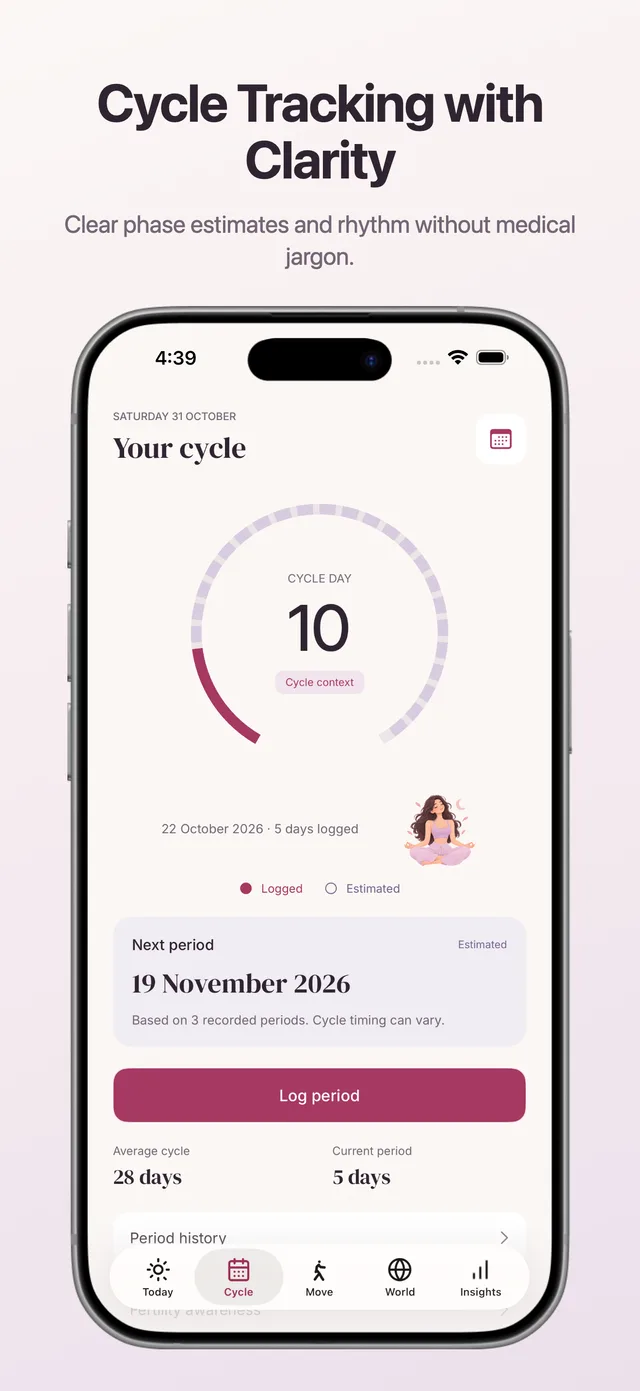
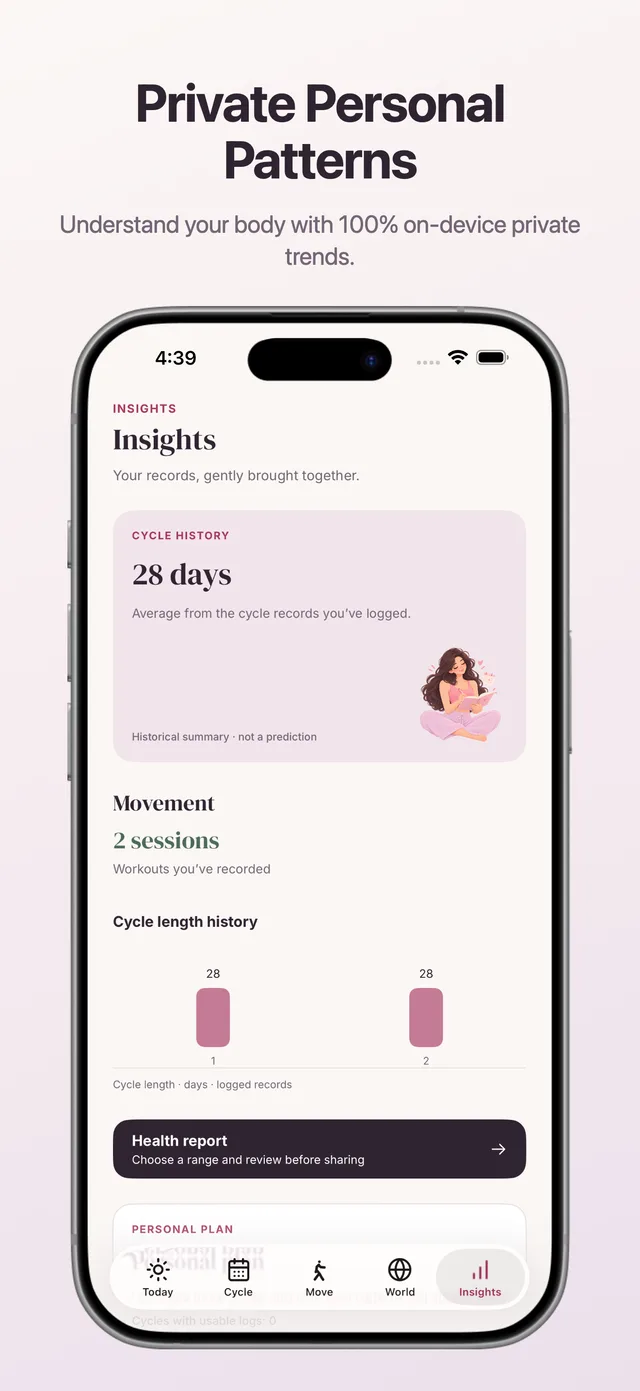
Records stay on your phone, and no account is required. Predictions are estimates from the data you log, and they can vary. To learn how local on-device encryption protects your sensitive health entries, read our audit on is a period tracker safe for health data?.
Track your cycle length in Yuvix. Log your period dates and see the length of each cycle on your phone.


Frequently asked questions
Is a 28-day cycle the only normal length?
No. The NHS says periods commonly come every 21 to 35 days, and 28 days is the average (NHS, Periods).
Does spotting before my period count as day 1?
No. Day 1 is the first day of bleeding, so spotting before the period is not counted as day 1.
How many cycles should I track?
Track at least three cycles. One cycle rarely shows a pattern. Three or more give a range you can compare.
When are periods considered irregular?
The NHS defines irregular periods as a gap of less than 21 days or more than 35 days (NHS, Irregular periods).
When should I see a GP about my cycle?
See a GP if your periods are irregular or your usual pattern changes, if periods last longer than 7 days, or if you have bleeding between periods or after sex (NHS, Irregular periods; ACOG, Abnormal Uterine Bleeding).
Frequently Asked Questions
Is a 28-day cycle the only normal length?+
No. The NHS and ACOG state that regular adult cycles commonly range between 21 and 35 days. A 28-day cycle is just a mathematical population average, not an absolute target.
Does light spotting before my period count as Day 1?+
No. Day 1 is strictly the first day of full, continuous red menstrual bleeding. Preliminary brown spotting belongs to the end of the previous luteal phase.
How many cycles should I track before seeing a doctor?+
Clinicians recommend recording at least three consecutive cycles. Tracking three cycles gives an objective range of variation and helps identify whether cycle lengths differ by more than 7–9 days.


Sources
- NHS. "Periods." https://www.nhs.uk/conditions/periods/
- NHS. "Irregular periods." https://www.nhs.uk/symptoms/irregular-periods/
- American College of Obstetricians and Gynecologists. "Abnormal Uterine Bleeding." https://www.acog.org/womens-health/faqs/abnormal-uterine-bleeding
Health information only. This article does not diagnose or treat any condition. Yuvix is not a medical device and is not contraception.
Discussion & Reader Q&A
Moderated CommunityI was always worried because my cycle was 31 days instead of 28. Calculating from day 1 to the day before bleeding helped me realize my pattern is completely steady.
Leave a Comment or Question
Share your experience or ask a question about this guide. Links and URLs are automatically blocked.